|
Chiller Purge Systems: How They
Work

LOW PRESSURE REFRIGERANTS
Purge units are most commonly used on negative pressure chillers charged with R11 or R123
refrigerants. During operation, these chillers generate a 15 to 17 inch vacuum in the
evaporator, where chilled water is produced.
If leaks exist in the seals and joints of the evaporator, air will enter the chiller and
create a host of problems. Noncondensible gases entering the evaporator will migrate to
the compressor and ultimately collect in the condenser tube bundle. In the condenser,
these gases elevate the head pressure against which the compressor discharges. Too high of
a head pressure causes the compressor to surge, which drastically increases
energy consumption and damages expensive compressor components. Noncondensible gases also
insulate the tubes and decrease heat exchange efficiency between the condensing water and
the refrigerant. Water vapor that likewise leaks into the chiller generates rust and
highly reactive aqueous acids that corrode components.
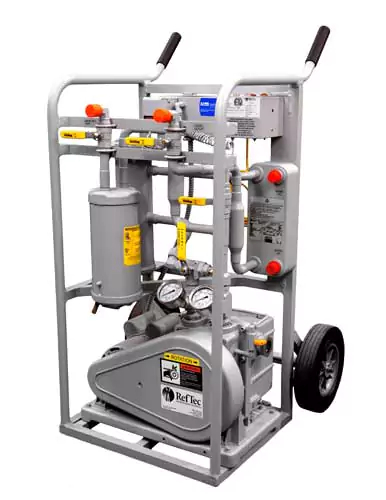
A purge units job is to remove noncondensible gases as rapidly as possible. The
EnviroPurge mounts permanently to a chiller and continuously draws condenser vapor into
its chilled purge vessel. As it is drawn over the vessels cooling coil, refrigerant
vapor condenses and pools in the bottom of the vessel where it is drawn back to the
chiller evaporator by pressure differential. Noncondensible gases separate and rise to the
top of the purge vessel. When the microprocessor determines that enough noncondensible
gases have been collected, a pump-out cycle is initiated in which the noncondensibles are
discharged to the atmosphere with negligible refrigerant loss.
HIGH PRESSURE REFRIGERANTS
With the growing popularity of high pressure chillers, we see an increasing occurrence of
noncondensible gas contamination in R22, R134a, etc. systems. Since these systems rarely
operate at negative pressures, improper recovery or evacuation practices are typically to
blame. In the past, elimination of air from these refrigerants was difficult. Today, the
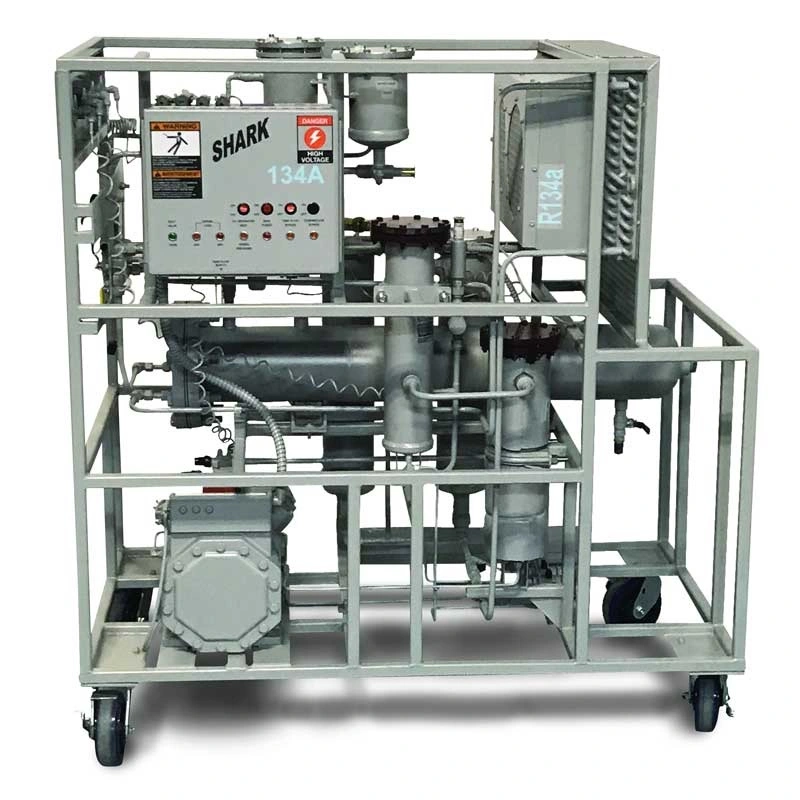
MiniPurge purges noncondensible gases from high pressure refrigerants quickly and
economically.
While the EnviroPurge separates noncondensibles by chilling the refrigerant, the MiniPurge
uses pressure. An on board compressor actively draws vapor from the chiller condenser
(making the process very fast) and compresses it in a separation vessel. Compressed
refrigerant vapor condenses in the bottom of the vessel and is forced back to the cooling
system. Meanwhile, noncondensible gases separate and rise to the top of the vessel. When
the microprocessor determines the most efficient pump-out cycle, the noncondensible gases
are expelled, again with negligible refrigerant loss. |
|